
You check the tracking page expecting a delivery update. Instead, it says the article was refused. A few days later, the envelope returns to your address.
The first reaction is often that the notice has failed. The second is to tear open the packet, check the pages and send it again immediately.
Pause long enough to preserve the record.
A refused or unclaimed notice can still have legal consequences, but the result depends on the address, postal record and applicable law. A returned packet is evidence to examine, not an automatic finding that service succeeded or failed.
This opening describes an illustrative situation. The next steps are about preserving dispatch records while your advocate assesses the legal position.
Read the actual postal remark
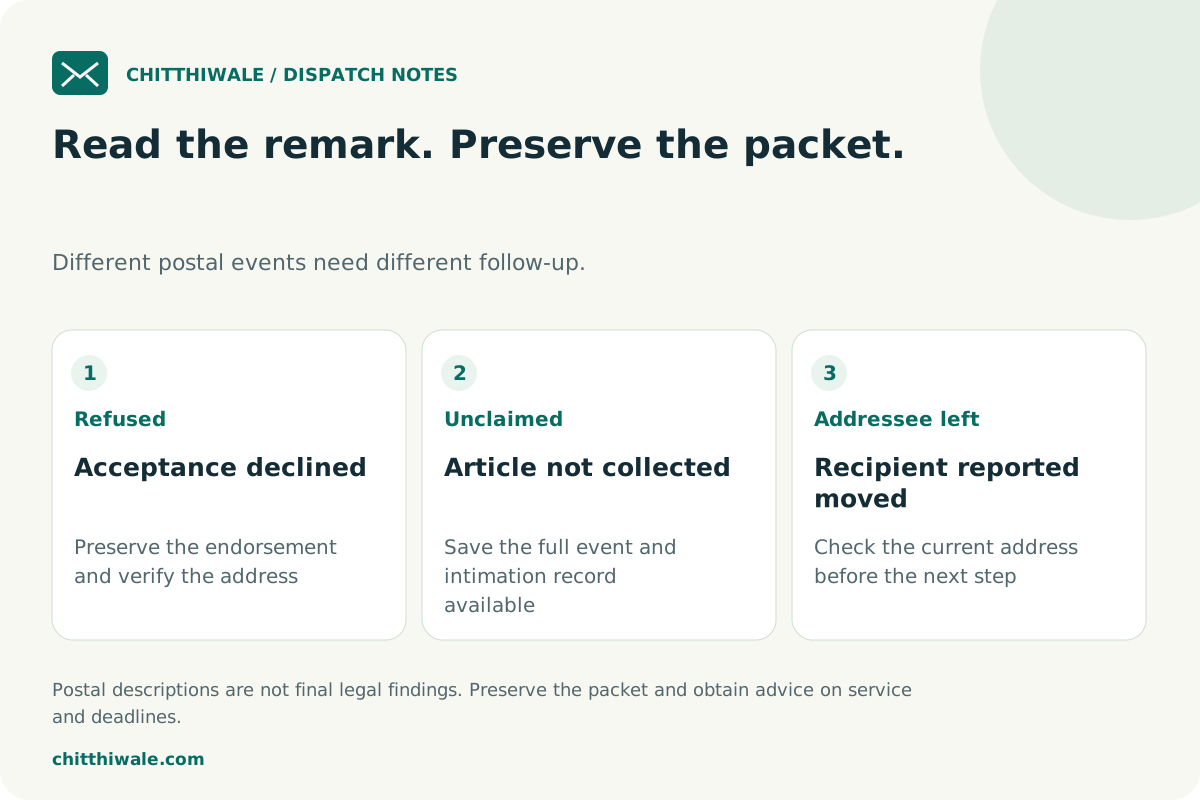
“Refused”, “unclaimed” and “addressee left” describe different events. Save the wording exactly as it appears. Do not replace all three with “delivery failed” in your office register.
| Postal remark | What it generally indicates | Useful next step |
|---|---|---|
| Refused | Acceptance was declined according to the postal record | Preserve the endorsement and verify the address |
| Unclaimed | The article was not collected after the relevant process | Save the full event history and available intimation details |
| Addressee left | The person is reported to have moved | Investigate the current address and take advice |
| Insufficient address | The address could not support delivery | Check the missing details before a fresh dispatch |
| Door locked or absent | Delivery could not be completed at that attempt | Check later events rather than assuming a final result |
These are practical descriptions, not legal conclusions. The complete history and the physical endorsement may contain more detail than the status summary on a phone screen.
What deemed service means in practice
Section 27 of the General Clauses Act provides a rebuttable postal presumption when its conditions apply. The present wording refers to proper addressing, prepayment and posting by speed post with registration. The governing enactment and any contrary intention also matter.
In plain terms, the absence of a recipient's willing acceptance does not always prevent a sender from establishing service. It does not excuse posting to an address you know is wrong.
The Supreme Court's C.C. Alavi Haji decision, (2007) 6 SCC 555, is a leading authority on cheque-dishonour notices and postal presumptions. Its reasoning does not mean that every returned envelope in every type of dispute is automatically served.
D. Vinod Shivappa, (2006) 6 SCC 456, also shows why the evidence surrounding avoidance matters. A postal remark needs to be read in context.
Preserve the returned envelope before doing anything else
Photograph both sides of the packet in good light. Capture the address, article number, postal markings, return remark and seal condition. Save the original image files.
Keep the packet intact and protected. Record the date you received it in a separate note or sleeve. Avoid writing across the original endorsement, removing labels or attaching staples through a seal.
Ask your advocate before opening or reusing it. Whether and how the packet is produced, marked and examined in court depends on the proceeding. There is no need to invent a universal rule that every returned envelope must be opened by a judge.
Recheck the address with the source you used
Look at the lease, agreement, invoice, recent correspondence or other record that supplied the address. Compare it with the actual envelope, character by character.
Was a flat number omitted? Did the label use an old office? Was the notice intended for a company but addressed only to a person's nickname?
If the recipient recently used the same address in correspondence, preserve that correspondence. If you discover a genuine mistake, tell your advocate promptly. A clear correction is more useful than describing every return as deliberate evasion.
Keep address verification separate from assumptions about motive. “The agreement lists this address” is a recordable fact. “They are hiding” may only be a suspicion.
Do not restart the legal clock yourself
A second notice may be sensible in some matters, but it does not automatically reset every deadline. Likewise, waiting indefinitely for a better tracking status can consume time needed for the next step.
Send your advocate a compact set of records: the notice, booking receipt, saved tracking, returned-envelope photographs and address source. Ask for the date to diarise and the appropriate next dispatch instruction.
For cheque-dishonour matters, use the Section 138 dispatch guide to understand which dates your office should record. Have the actual calculation checked for your case.
If you send another copy, create another record
Use a fresh dispatch reference and retain both histories. Record why the second address was chosen and which version of the notice was sent.
Do not overwrite the original article number in your spreadsheet. The first dispatch may remain relevant even when a second attempt reaches the recipient.
If a permitted electronic copy is also sent, retain that separate transmission record. Keep the contents consistent unless your advocate deliberately revises them.
How Chitthiwale helps with the practical step
Once you have a prepared PDF and a confirmed dispatch instruction, Chitthiwale can handle the physical dispatch and optional e-signature. You retain responsibility for the recipient information and the legal decision to send again.
Download your order records and add the return material to the same matter folder. The aim is a history that can be followed from the first approved PDF to the last postal event.
Questions about returned notices
Does refusal mean I have won the case
No. Service is one issue. The claim, defence and remaining requirements still need to be established.
Is unclaimed exactly the same as refused
The remarks describe different postal events. Their legal effect depends on the evidence and applicable rule.
What should I do with an addressee-left remark
Preserve it, investigate the address and obtain the next instruction. Do not treat it as proof of deliberate refusal without supporting facts.


