
The last working day has passed. The laptop has been returned. The employee portal has stopped opening. The salary credit has still not arrived.
Consider Arjun, who has sent polite reminders to HR and received only a message that the settlement is “under process”. He has now prepared a formal demand and needs a record that it reached the right organisation.
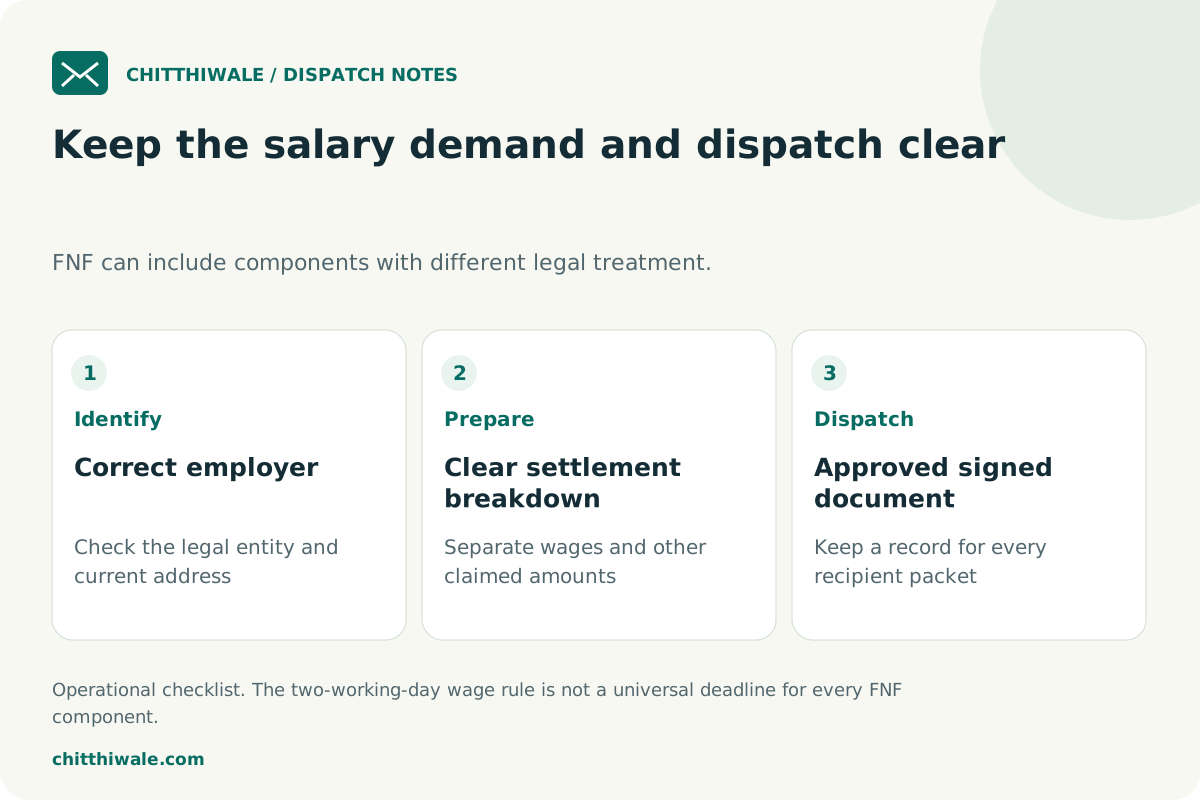
A prepared unpaid-salary or full-and-final demand can be dispatched to the employer's verified address through an online dispatch service. Keep the salary calculation, legal contents and recipient decision separate from the practical work of signing, printing and posting.
Arjun's situation is illustrative. A notice does not guarantee payment, and the legal route depends on the employment and the amounts claimed.
Identify the employer before choosing the address
The brand on your ID card may not be the legal entity named in your appointment letter. Check the employment agreement, payslips and other reliable records for the correct employer name.
If the employer is a company, verify its current registered-office information through the appropriate official source. Your adviser can decide whether the registered office, workplace, HR address or more than one address should receive a copy.
An email sent to an individual recruiter does not necessarily reach the organisation responsible for paying you. The postal packet needs a complete address and the proper entity name.
Separate unpaid wages from the rest of FNF
Full-and-final settlement is an umbrella phrase. It may include salary, leave encashment, reimbursements, incentives, deductions and other benefits, each with its own basis.
| Component | What to check | Useful record |
|---|---|---|
| Unpaid salary | Period worked and payments received | Payslips, attendance and bank entries |
| Leave encashment | Applicable entitlement and balance | Policy and leave statement |
| Reimbursement | Submitted and approved expenses | Claims and approvals |
| Incentive or bonus | Terms and eligibility | Plan, offer or award communication |
| Proposed deduction | Basis and amount disputed | Settlement sheet and correspondence |
Do not copy a gross salary figure into every line. Reconcile what is due and what has already been paid. Your notice should make the amount understandable to someone opening the packet for the first time.
Check current wage timelines without overstating them
The Code on Wages, 2019, Section 17, addresses wage-payment timing, including a two-working-day rule for wages payable following the specified forms of separation, including resignation. The commencement notification brought the relevant provisions into force on 21 November 2025.
That does not mean every FNF component must always be paid within two working days. Coverage, the statutory meaning of wages, applicable government provisions and other entitlements need to be checked.
Also, a pre-action demand is not universally a mandatory “statutory notice” for every employee claim. Have your adviser identify the appropriate demand, deadline and forum. Chitthiwale handles the dispatch step after those decisions.
Preserve evidence before access disappears
Keep the employment documents and communications you are lawfully entitled to retain. Useful records may include your appointment letter, payslips, resignation acceptance, relieving communication and settlement statement.
Avoid downloading unrelated customer information, confidential business files or material you are not authorised to keep. A salary dispute does not make every company document relevant.
If a portal has already closed, record what you do have and ask for missing employment or settlement records through the appropriate channel. Do not invent a payroll statement to fill the gap.
Finalise the signature and the dispatch copy
Review the approved PDF for your name, employer name, employment dates, amount and list of enclosures. Check that each attachment is readable.
If the document needs your signature, complete an appropriate method before dispatch. Optional e-signature can be convenient when you are away from a printer. It does not determine whether the demand is legally correct.
Keep the signed source file and the version approved for printing. If your advocate signs and sends the notice, follow that arrangement rather than adding another signature without a reason.
Arrange dispatch to the verified address
Chitthiwale takes care of dispatch and optional e-signature for the document you provide. Enter the verified recipient details, check the order and confirm the expected booking date.
Where your adviser specifies registration or proof of delivery, confirm the exact booked service and records available. Check the dispatch charges before paying.
Save the booking receipt against the notice reference. If you send separate copies to the registered office and workplace, preserve a separate article number and outcome for each packet.
Follow up with a complete record
Add tracking and available delivery proof to the same folder. If the packet is returned, preserve its markings and ask for advice before assuming what the return means.
If the employer proposes a settlement, compare the written breakdown with your demand. Record any payment before communicating an updated balance.
Sending a notice does not, by itself, pause every limitation period or replace a complaint to the appropriate authority. Keep your adviser informed while you wait. A dispatch service is not monitoring the legal deadline for you.
Questions before posting
Can I send an unpaid-salary notice without returning to the office
You can arrange remote dispatch of the prepared document to the verified employer address.
Can Chitthiwale recover my salary
Chitthiwale handles dispatch and optional e-signature. Recovery advice, representation and further action remain with you and your adviser.
Should every HR employee receive a copy
No general rule requires that. Choose recipients for a clear reason and avoid circulating personal employment information unnecessarily.
Is FNF always the same as wages
No. Separate the components and check the basis and payment rules for each before preparing the final demand.


