
The envelope arrived. That much is agreed. The disagreement starts with what was inside it.
Imagine a payment dispute in which the sender produces a delivery record and the recipient says the packet contained blank pages. The sender remembers printing the notice. The assistant remembers taking an envelope to the post office. Neither kept a record connecting those two events.
To support what you sent, preserve a connection between the final document, its printing and packing, and the postal article number. Tracking alone usually describes the packet's journey, rather than its page-by-page contents.
This is an illustrative dispute, not a claim about how often an empty-envelope defence succeeds or appears in court.
Begin with the question the receipt cannot answer
A booking receipt can help show that an article was posted. A delivery update can help show what happened to that article. Neither ordinarily reproduces the notice and every enclosure inside it.
That gap does not make posting pointless. It tells you which additional records are useful.
Think of the file as a set of connected records. The approved PDF is the starting point. Printing and packing connect it to a physical packet. The booking record connects the packet to its postal journey. Each connection should be understandable to someone who was not present.
Freeze the document before anyone prints it
Choose one approved PDF and give it a clear reference. Include the notice, the intended annexures and a page count. Remove draft comments and check that every page opens correctly.
If a signature is required, complete it in the proper sequence. Preserve the signed electronic file as supplied. Later changes, including added marks or page scaling, can affect signature validation. Keep any print-layout version separately and record its relationship to the signed source.
Do not replace the approved file with a revised version after booking and leave the same filename. If a correction needs a fresh dispatch, create a fresh record.
What Notice IDs, QR codes and hashes can do
| Record or tool | Its practical role | Its limit |
|---|---|---|
| Unique Notice ID | Connects records for the same notice | An ID can be copied unless the process is controlled |
| Page numbering or QR reference | Helps identify the intended packet version | A printed code does not prove physical insertion |
| SHA-256 hash | Helps compare the bytes of a preserved file | It does not inspect an envelope |
| Packing record | Records the preparation and handover | Its reliability depends on how it was created |
| Postal article number | Connects the packet to postal events | It usually does not list the contents |
A SHA-256 hash is a digital fingerprint calculated from a file. Calculate it again from the retained file and compare the values. Matching values can support that the file bytes are unchanged from the recorded version, provided that the earlier hash record is itself reliable.
The fingerprint says nothing by itself about who printed the document or whether someone inserted it into a particular envelope. Those are physical steps.
Similarly, a QR code is useful only when it resolves to an appropriate verification record. It should not reveal a confidential notice to anyone who photographs the envelope.
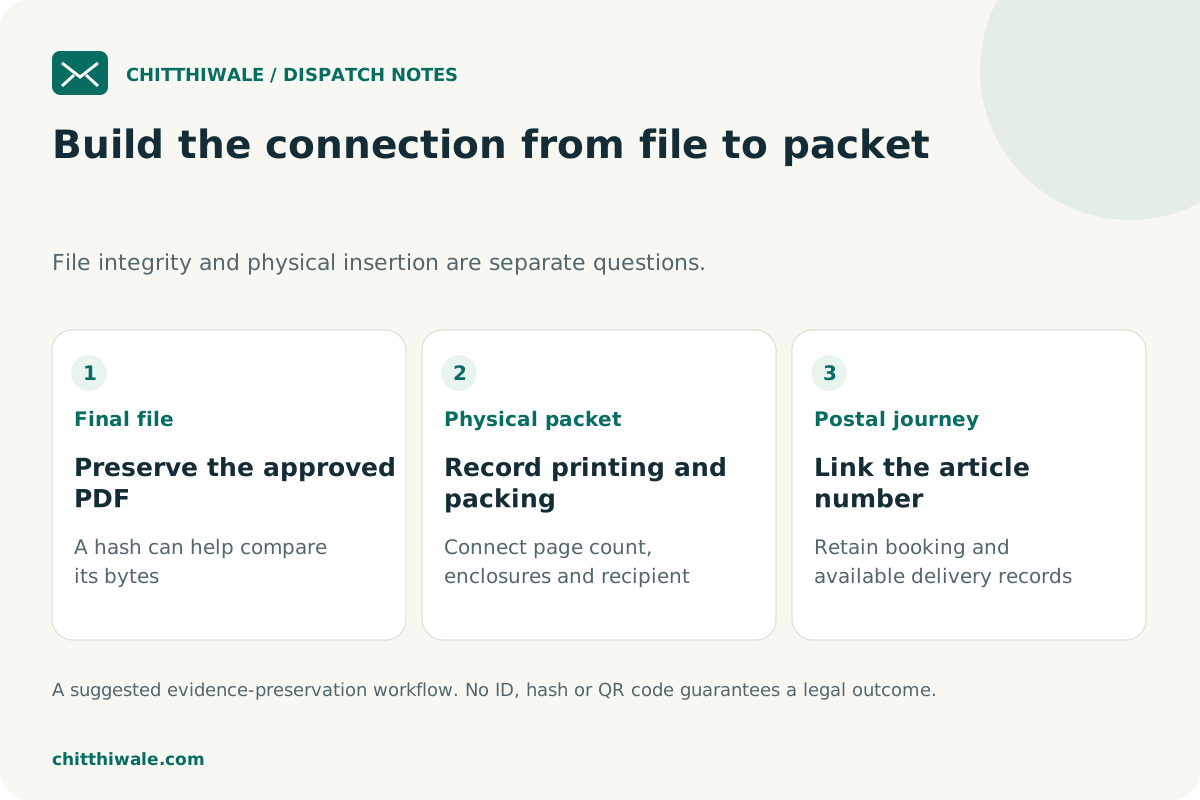
Build a practical packing record
If your office prepares the packet, record the notice reference, page count, enclosures, recipient, address and person responsible. Connect that entry to the article number after booking.
Where appropriate and lawful, photographs or a continuous packing video may support the process. Show enough to identify the document and packet without exposing unrelated client papers. Preserve the original recording and its metadata.
A photograph of a sealed envelope is useful for its address and external condition. It does not show the pages inside. A clip that begins after sealing leaves the same gap.
For regular dispatches, a consistent written packing process is easier to explain than a special recording made only when trouble is expected. Make sure staff can describe what they actually did.
Ask your dispatch provider specific questions
If another team prints and posts your PDF, ask what record links your uploaded version to the dispatched article. Ask which records can be downloaded and how long they remain available.
Request a sample using non-confidential test material if you want to understand the workflow. Check whether the sample identifies the source file, page count, dispatch date and postal reference.
Do not assume that every platform offers page-level QR codes, hashes, packing recordings or permanent archives. Confirm the features included in your order. A marketing phrase such as “court proof” is not a substitute for a usable record.
Keep electronic evidence in its original form
Store original PDFs, photographs and videos as well as convenient viewing copies. Record who created or downloaded each file and when. Avoid repeatedly forwarding the only copy through services that compress or alter it.
If the material will be submitted electronically in litigation, ask your advocate about the applicable evidence requirements. The electronic-record preservation guide explains the dispatch records worth saving and where Section 63 of the BSA fits.
An automatically generated document should be checked for its source, scope and signatures before it is relied on as a legal certificate.
What if the recipient already claims the envelope was empty
Preserve the records that exist now. Collect the approved notice, printing instructions, dispatch correspondence, receipt, tracking and any contemporaneous packing material.
Write down who handled each stage while memories are fresh, clearly separating personal recollection from recorded facts. Let your advocate decide how those people and documents should be presented.
Do not reconstruct a packing log as though it was created on the posting date. A later explanation can identify its real date. An invented earlier record creates another problem.
Questions senders ask
Does a hash defeat an empty-envelope defence
It can support file integrity. Physical contents still require a reliable connection to the posted packet. The court evaluates the complete evidence.
Should I add QR codes to an already signed PDF
Check first. Keep the signed source intact and distinguish any later print version. A verification mark should never obscure text or compromise confidentiality.
What does Chitthiwale handle
Chitthiwale handles dispatch and optional e-signature. Confirm the records available for your order, then download them into your own matter file.


